by Gordon A. Dickson
Listen to this post:
The memorial service for Charlie Kirk on Sunday, September 21, 2025 was viewed by one of the largest (if not the largest) number of people in the history of electronic communication. The service included many wonderful references to the gospel, but also included a number of political statements.
Now, many are discussing the reality of genuine revival, but American history provides us with a caution. Churches in this country have experienced revivals, only to see those revivals cut short by political disagreements. (See the illustration from Kentucky below.) So, how should churches address politics?
(an excerpt from the book “12 Ways You Can Make a Difference in This Crazy, Mixed-up World” by Gordon A. Dickson) This is from chapter 32 entitled, “Churches and Politics.”
The church as a whole has no business in politics, but its individual members can make a significant difference in local politics.[i] Martyn Lloyd-Jones discussed this distinction between individual believers and the church as a whole. He wrote,
 There are those who say, “Yes, you are quite right, it is not the business of the Church as a Church to intervene in political, economic or social conditions. What I say is that the Christian should have nothing whatsoever to do with these things; the Christian must not register his vote, he must have nothing to do in the control of affairs and society.” That, it seems to me, is an equal fallacy; for the Christian as an individual, as a citizen in a state, is to be concerned about these things. . . . As Christians we are citizens of a country, and it is our business to play our part as citizens, and thereby act as salt indirectly in innumerable respects. But that is a very different thing from the Church’s doing so.[ii]
Individual believers can voice their convictions on issues and candidates, but not at the expense of congregational unity. Political disputes can quench the work of God’s Spirit within a local church. Indeed, revivals in churches (such as one in Mason County, Kentucky, in 1798) have been quenched by political agitations.[iii]
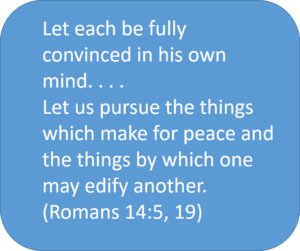
Individual Christians must exercise their constitutional rights as their consciences dictate and align their votes with their biblical values. But, within a congregation, “Let each be fully convinced in his own mind. . . . Let us pursue the things which make for peace and the things by which one may edify another.”[iv]
A church as a whole can and must speak to the issues of the day. This is part of being the salt of the earth and the light of the world. As Lloyd-Jones noted, there are those who say a church should not “intervene in political, economic or social conditions.” But what should the church do when significant moral 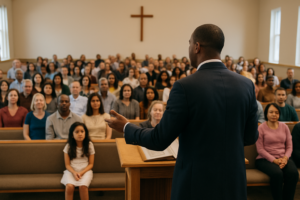 evils are politicized or even legalized by the state? Should churches preach and teach about these as these issues of right and wrong? Or should the church avoid all issues that the state has claimed as its own? When the state legalizes euthanasia, the abortion of infants, dangerous drugs, or gambling, should the church remain silent? Or should the church be like Daniel when he respectfully confronted King Nebuchadnezzar, saying,
“Therefore, O king, let my advice be acceptable to you; break off your sins by being righteous, and your iniquities by showing mercy to the poor. Perhaps there may be a lengthening of your prosperity.”[v]
The answer is obvious; is it not? The only remaining question is whether each pastor and each congregation will have the courage to speak truth to powerful people. Remember, “God has not given us a spirit of fear, but of power and of love and of a sound mind.”[vi]
When the state legalizes euthanasia, the abortion of infants, dangerous drugs, or gambling, should the church remain silent?
A church would be unwise to endorse individual candidates but should speak to the moral issues of the day.
[i] “Politics” refers to the government of the people.
[ii] D. Martyn Lloyd-Jones, “The Salt of the Earth,” Monergism, accessed October 12, 2023, https://www.monergism.com/thethreshold/sdg/salt.html.
[iii] See John B. Boles, The Great Revival: Beginnings of the Bible Belt (Lexington: The University Press of Kentucky, 1996), 51–52, Kindle. In that case, the contention was about the way the Constitution of Kentucky should be written.
[iv] Romans 14:5, 19.
[v] Daniel 4:27.
[vi] 2 Timothy 1:7.
(c) Gordon A. Dickson, 2025