As the nation mourns the death of Charlie Kirk, Christians must think calmly and carefully. What is it that our country needs from us at this moment? Is there not a cause?
Listen to this article
Is There Not A Cause?
Rising to the challenge of a God-honoring cause will enable you to do far more than you ever dreamed possible.
Centuries ago, in the Elah Valley in Israel, a young shepherd stood trembling with excitement as he watched the crowd around him. Moments earlier, all eyes had been on the massive warrior standing defiantly before them. That

soldier’s terrifying taunts had caused the king and his armies to cower in despair. Too fearful to make a move, they stood stymied by a standoff, now lasting nearly six weeks. Who could do battle with such a superb soldier? But now, the eyes of many had turned to look at the mere shepherd boy. A moment earlier, the boy had blurted out the question, “Who is this uncircumcised Philistine, that he should defy the armies of the living God?”[1]
The boy’s siblings noticed the sudden interest in their youngest brother and scolded him. His oldest brother, Eliab, mocked, “Why did you come down here? And with whom have you left those few sheep in the wilderness? I know your pride and the insolence of your heart, for you have come down to see the battle.”[2] And the shepherd boy, David, responded, “What have I done now? Is there not a cause?”[3] And you know the rest of the story. David went on to destroy Goliath, the terrifying giant.
Throughout this book, we have learned that there are God-honoring causes today in which we can battle courageously like David. Why? Because entire movements are dedicated to challenging the glory of the living God. So the simple question for each one of us today is this: Is there not a cause? Is there not a reason for us to get involved? This is not an appeal for violence; we are not talking about using weapons. But there is a cause. The apostle Paul explained it this way:
For the weapons of our warfare are not carnal but mighty in God for pulling down strongholds, casting down arguments and every high thing that exalts itself against the knowledge of God, bringing every thought into captivity to the obedience of Christ.[4]
To the glory of God, we must use our God-given discernment to overturn wicked arguments. We are not to be good for nothing but to be cast under the feet of men. There is a cause.
Taking up a God-honoring cause and rising to the challenge will enable you to do far more than you ever dreamed possible. Modern students of the Greek language have to learn the Granville Sharp rule.[5] But what they may not know is that Granville Sharp learned Greek to defend his Christian faith. On one occasion, Sharp expressed his belief that Jesus Christ is God. An 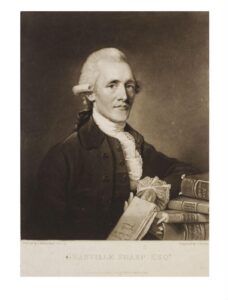 acquaintance told him that the only reason he believed that was because he did not know Greek. So Sharp studied Greek. In fact, he studied so diligently that he wrote a rule of Greek grammar that each modern student of Greek now has to learn!
On another occasion, one of Sharp’s Jewish acquaintances denied that the promises of the Messiah apply to Jesus. When Sharp disagreed, his friend told him that it was because he did not understand Hebrew. So Sharp diligently set to work and mastered ancient Hebrew! But Sharp’s faithful intellectual work paid off in more ways than one. And he changed the course of British history.[6] How, you might ask? Read on.
Undoubtedly, Sharp was diligent with his linguistic ability. But you don’t require a talent for languages to be pungent salt and brilliant light in your city and state. In preparation for writing this book, I spoke with several people who acted on this simple truth: there is a cause! And, because they knew that there was a cause, they got involved. Their efforts have brought vivid light into areas of public policy that had begun to founder in darkness.
Taking up a God-honoring cause and rising to the challenge will enable you to do far more than you ever dreamed possible.
One lady I interviewed began to direct some pointed questions to the local school officials in her county in South Carolina. She had been asked to do so by a concerned parent. That parent passed along two of the summer reading books that had been issued by the county school district. Both books were full of perverse material that totally contradicted many parents’ moral values. Local education officials had expended more than one hundred thousand dollars on that summer reading program for K–12 students. But now they were being called into account for how those dollars were spent.
When the education officials finally called the lady back on a conference call, their answers were evasive. So she signed up to speak for three minutes at the school board meeting to ask pointed questions. Suffice it to say that her efforts generated serious concern. One of the reasons for that concern is that school boards like the one in Loudon County, Virginia, are now very much in the news. Parents are becoming aware of what their children are being taught, and they are taking a stand. They are shining their lights into the darkness.
Groups such as Moms for LibertyTM have begun to raise the alarm in other school boards around the country.[7] So if you will step up and begin to ask persistent questions, you will find that your efforts alert others about what is really going on in your local school district.
You could be like the woman in Scripture who continued to appeal to the unjust judge.[8] It is likely you will find that taxpayer funds are being used to contradict the moral values of local citizens. Suffice it to say that when your local officials learn that you are paying attention, your influence will be like light shining in the darkness. No one is asking you to be obnoxious. Simply start asking questions, kindly but firmly. You will make a difference in this crazy world. Is there not a cause?
Proclaiming the light of the glory of the gospel is the highest calling for every believer. As we learned in an earlier chapter, this is why the people of Indiana are called “Hoosiers.” Their early pioneers were nicknamed “Hoosiers” because it was so obvious that their lives had been changed by the gospel, which had been preached gloriously by the Black evangelist Harry Hoosier.[9] He did not have Granville Sharp’s educational background, but he gave his efforts and energies to glorify God.
Simply start asking questions, kindly but firmly. You will make a difference in this crazy world.
One day Sharp was shocked by the sight of a bloodied slave whose master had beaten him within an inch of his life. In that moment, Sharp knew that he had to act. With the help of his brother, a well-known doctor, Sharp helped the poor slave to recuperate. Then he helped the man, named Jonathan Strong, to get a job with a local apothecary.
But one day the slave owner saw his slave, whom he had thought to be dead, and he immediately had him imprisoned. When Sharp found out about this, he raced to have the slave released into his custody. Then the slave owner sued Sharp, and Sharp faced what seemed to be an insurmountable battle to free Strong for good. Friendly attorneys told Sharp that he had no case and that the slave would go back his owner.
But that was not enough for Sharp. In his own words, he took up the cause “to make a hopeless attempt at self-defence.”[10] Using the same diligence that he learned from studying the Scriptures, Sharp began to study the law.
After many hours of study, Sharp discovered a principle in English law that he could use to defend Strong. He argued that the slave was a human being who lived on English soil and was entitled to liberty. In fact, he went on to show how slavery contradicted the law of England. His work ultimately overturned the presumed rights of slaveholders. And this is why Sharp, a student of the Bible and English law, is considered to be the father of the abolitionist movement in Britain. Men such as William Wilberforce and John Newton drew on Sharp’s work to abolish slavery in the United Kingdom.
Rising to the challenge of a God-honoring cause will enable you to do far more than you ever dreamed possible. Take the next step. You could be like David or Granville Sharp or Harry Hoosier. You can make a difference in a crazy, mixed-up world. Is there not a cause?
[1] 1 Samuel 17:26.
[2] 1 Samuel 17:28.
[3] 1 Samuel 17:28–29.
[4] 2 Corinthians 10:4–5.
[5] “Granville Sharp’s Rule is a grammatical principle applied to the translation of New Testament Greek whereby the deity of Christ is explicitly affirmed. This is specifically associated with the translation of Titus 2:13 and 2 Peter 1:1.” (Theopedia, s.v. “Granville Sharp’s Rule,” https://www.theopedia.com/granville-sharps-rule.)
[6] “Protestant Profiles # 19: Granville Sharp [and the British Abolitionists],” Theology, Society & Culture, The Lion & Phoenix, accessed October 13, 2023, https://lionandphoenix.wordpress.com/2017/08/01/protestant-profiles-19-granville-sharp-and-the-british-abolitionists/.
[7] See the Moms for Liberty website at https://www.momsforliberty.org/.
[8] See chapter 28: “Prayerful Persistence.”
[9] Stephen H. Webb, “Introducing Black Harry Hoosier: The History Behind Indiana’s Namesake,” Indiana Magazine of History 98, no. 1 (March 2002), 30–41.
[10] “Protestant Profiles # 19: Granville Sharp,” The Lion & Phoenix.
This article an excerpt from the book, “12 Ways You Can Make a Difference in This Crazy, Mixed-up World” by Gordon A. Dickson, (c) 2023

“12 Ways You Can Make a Difference in This Crazy, Mixed-up World”