Picture this. You are standing among the trees on the island of Java in Indonesia. Suddenly something in the sky catches your eye. Is it a bird? Is it a plane? As you look up you see what looks like tiny paper airplanes soaring through the air above you. Where did they come from? When you stop to consider how the Lord designed this world, you have to marvel at the way plants spread their seeds. As they do, they fill the earth with the glory of God.
And the earth brought forth grass, and herb yielding seed after his kind,  and the tree yielding fruit, whose seed was in itself, after his kind: and God saw that it was good. (Genesis 1:12)
When plants release their seeds, gravity usually takes over. What’s the problem? If all the seeds land in the same spot around the tree or plant, they will crowd each other out as they try to grow. How did our Creator design a solution to this problem?
Taking Flight
The Java cucumber has edible seeds – if you can catch them. The Lord designed those seeds (called “samara”) with papery wings that make them
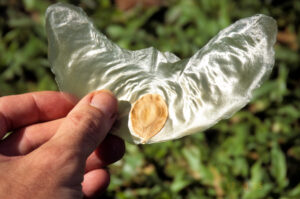
look like tiny paper airplanes. The plant’s vines climb high into trees in the tropics and produce gourds that split open. When they do, they send their winged seeds flying far and wide. Those traveling seeds are blessed with the flying wing design like many military aircraft. That design – which uses the entire surface of the craft to provide lift – is difficult to control. But the Lord designed the Java cucumber to overcome this problem by placing the seed almost exactly in the center between the two wings. The wings are tilted slightly upward so that the seeds will fly straight. And away they go, 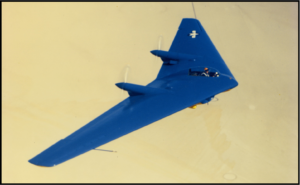 often traveling several hundred feet from the gourd that launched them. When they crash, into the soil and are covered by leaves or other vegetation, they are ready to germinate and grow. It’s fun to watch these seeds fly in online videos.
Ideas from Seeds: The Invention of Velcro
Consider what we learn from the way the Lord made burdock cockleburs. Burdock, a native plant from Europe and Asia, has edible roots. These roots are used in many root beer recipes and in Asian cuisine. In 1948, a Swiss engineer, George de Mestral, took a long walk with his dog in the woods one day. When he returned home, he found that his dog and his own clothing were full of burs. As he patiently pulled them out of his dog’s hair, George got an idea. Why not put a bur under the microscope to see why they attached to everything so easily? When he did, he saw that each one was covered with tiny hooks, ready to snag anything with a loop, such as hair or clothing.
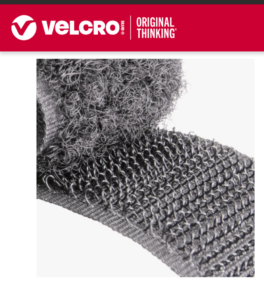
Thinking like an engineer, he began to wonder if there were any practical or commercial applications for this. How could he replicate what he had observed in nature? How could he develop a hook and loop system? It took him nearly 10 years, but when he began to experiment with nylon (which had been invented in 1938), the plan came together. He called the hook and loop system Velcro® and now you know the rest of the story. So this week, when you hear that ragged rasp when you pull off your child’s shoes, or adjust your backpack, think of how our Lord created burdock cockleburs in great wisdom. George de Mestral’s invention is considered to be one of the foremost examples of biomimicry – inventions that imitate God’s creations.
If you will stop to look for them, you will see that seeds fill the earth to proclaim the unique excellence of their Creator.
This blog post is part of my forthcoming book on the theme of “God’s Extraordinary Glory in Ordinary Things.” This will be a companion work to my forthcoming book: “TRUST. What religions don’t tell you but you can find out for yourself.” This will be released soon. You can learn more about this presentation of gospel G.R.A.C.E. at https://liveservelead.com/rough-draft-book-audiobook-trust/

Gordon A. Dickson is the author of “12 Ways You Can Make a Difference in This Crazy, Mixed-up World.” It’s available as a paperback, ebook and audio book here